Recent developments in the parking market have been felt most sharply by those of us operating parking facilities every day. The administration of National Car Parks (NCP) has brought those pressures into sharper focus, not as headlines, but in practical conversations. With landlords reassessing risk, season ticket holders asking about continuity and pre‑paid parking, and operators dealing with the reality of running assets in cities that have changed structurally since the pandemic.
Every parking operator has faced the same underlying challenges: hybrid working, more variable demand, rising costs and higher customer expectations. The difference has been how operators responded once it became clear that historic demand patterns were no longer fixed. In a consolidating market, where scale alone no longer guarantees resilience, standing still has become an active risk.
Periods of market disruption tend to surface most clearly for season ticket holders. These are customers who commit in advance and expect continuity in return. When conditions change, questions around access, continuity and the treatment of pre‑paid arrangements quickly come to the forefront.
At Q‑Park, season ticket holders are treated as long‑term customers rather than short‑term commitments, and facilities are managed accordingly. That approach places emphasis on consistent reinvestment: Lighting, surfaces, signage, cleanliness and legibility quickly signal whether a facility is actively managed, shaping confidence and trust over time.
In practice, it comes down to a few fundamentals:
- Consistent reinvestment, in lighting, surfaces, signage, cleanliness, safety and on‑site staff, supported by ongoing monitoring and long‑term maintenance to protect assets and reduce risk.
- Seamless access with sustained investment, in digital access, digital payment and third‑party integration; using ANPR and the Q‑Park App to improve reliability and reduce friction.
- Integrated mobility, where EV charging and partner services are designed into the site, not treated as afterthoughts.
- Operational flexibility, so parking facilities can adapt as demand patterns shift rather than relying on fixed assumptions.
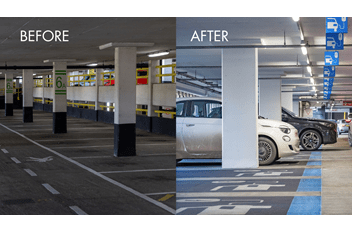
The Windsor Royal refurbishment shows how this plays out in practice: structural repairs to protect the asset, durable deck coatings to reduce long‑term maintenance demand, upgraded LED lighting with intelligent controls, and expanded EV charging infrastructure. It’s more than cosmetic upgrades, it involves decisions about longevity, safety and continued relevance, for customers, landlords and city centres alike.

Operationally, one of the clearest lessons of recent years is how quickly friction changes behaviour. Queueing, unclear tariffs, awkward payment journeys or inconsistent access ultimately generate avoidance.
That’s why ANPR‑based access has become an important part of modern operations. When implemented properly, it reduces friction at entry and exit, improves reliability, and, particularly through pre‑booking, helps convert search demand into committed journeys.
As the role of parking within cities evolves, car parks are increasingly acting as points of connection rather than standalone destinations. Well‑designed mobility hubs bring multiple services together, from EV charging and shared vehicles to cycle provision and digital access, all creating value through integration which offers choice and supports practical city‑centre access.
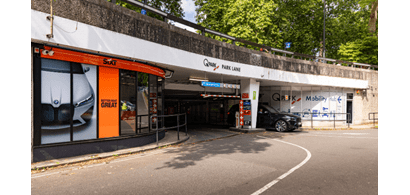
Our mobility partners consistently describe these hubs as centralised pick‑up points where different services operate as an interconnected ecosystem. That integration supports changing travel behaviour, strengthens destinations for landlords, and allows parking assets to remain flexible for alternative uses such as locker points, city logistics, bicycle parking and car‑sharing.
This perspective is shaped by long‑term operational experience. Q‑Park began operating in the UK in 2001, and over more than two decades has seen how quickly assumptions about demand, usage and value can shift. That history reinforces a simple lesson: parking assets that are properly managed, reinvested in and designed around real user behaviour are far better positioned to adapt when conditions change.
Consolidation has a way of exposing which operating models are resilient and which rely too heavily on historic assumptions. Models built on deferred investment and guaranteed demand struggle to adapt when conditions change. That doesn’t mean control or enforcement has no role, well‑run parking requires clear rules and consistent management but addressing evolving urban mobility needs also requires ongoing reinvestment and care. When that balance breaks down, the consequences are quickly visible.
About Q-Park
Q-Park is a leading off-street parking infrastructure owner and operator with well-managed commercial parking facilities across seven western European countries. We operate off-street parking spaces we own, have under concession or with long-term lease contracts from public and private landlords. We focus on off-street purpose-built parking facilities at strategic locations. We operate more than 5,300 parking facilities comprising over 1 million parking spaces in the Netherlands, Germany, France, Belgium, United Kingdom, Ireland and Denmark. Based on publicly available industry data for our competitors, we estimate that we are a top three player, based on the estimated off-street revenues, in all the countries in which we operate. Q-Park also has numerous mobility hubs which provide access to a variety of mobility solutions. We house and support a range of activities from last mile logistics, electric vehicle charging, micromobility and car sharing services which help support urban accessibility, sustainability and liveability.